how to turn public engagement into policy – beyond the citizens’ assembly
A citizens’ assembly is, by design, a room. People are selected, invited, briefed, seated, and asked to talk. It’s a genuinely useful room – better than most alternatives we’ve inherited from 20th-century democracy. But it is still a room, and policy made in isolation tends to arrive back in the real world a little perplexed.
This is an uncomfortable truth that few people say out loud as citizens’ assemblies have been gaining momentum: engagement has become very good at producing conversation, and only modestly good at producing policy that leads to action. We’ve built deliberative methodologies – assemblies, panels, hearings, workshops – around the idea that if you get a representative group of people in a room and facilitate the discussion well, good policy will follow. Sometimes it does. Often it stalls the moment it leaves the room, because it never had to prove itself – in a street, a season, a shortage of parking, or to a neighbour who disagrees.
I think it’s worth hypothesising why this might be the case. I believe that it’s rarely due to bad intentions. But I believe that standardised deliberative formats tend to look the way they do because they’re designed from the comfort of an office – by people for whom talking is already considered doing. When talking is your profession, it’s inevitable to start treating a well-facilitated dialogue as the work itself, rather than as what it actually is: a useful first step toward work that is to be carried out “out there”.
If we want policy that actually holds up in the society that it’s meant to govern, we need mechanisms that test ideas in that society beyond the beautifully designed deliberation format. That’s really the question this piece is trying to answer: not “to assembly or not to assembly,” but how you turn public engagement – any format of it – into policy that is shaped by the realities that it’s meant for.
In all honesty, we are no stranger to this diagnosis. We also like working by intensely typing on our keyboards. And have meetings. And continuously do and redo grant applications and project plans. But we are also trying to take what we believe to be our own medication. By using our senses and bodies to put in work. Although not always in strictly professional contexts, we consider this valuable. And we would like to do more of it!
what citizens’ assemblies are genuinely good at
To be clear: this isn’t an argument against citizens’ assemblies. I think that they’re one of the better inventions in modern participatory democracy, and for good reason – deliberative processes are associated with stronger climate policy, they can break political deadlocks, and they give people a structured, informed way to weigh in on issues that affect them. An assembly is often a great tool when a topic is genuinely complex and contested, where legitimacy depends on having a representative cross-section of the public on board, and where there is a preexisting political buy-in for recommendations.
However, a citizens’ assembly (however well run) isn’t a silver bullet – there are limits to what any purely deliberative format can do on its own.
real-world experimentation as a policy creation mechanism
Here’s the reframe: instead of treating public engagement as a way to collect opinions about a policy, treat it as a way to build and test the policy itself, in the place it is supposed to solve a challenge. Experimentation is how you learn what the policy should be, and how you find out whether it holds, before you commit real budget and real infrastructure to it at scale.
That means:
- Meeting people where they already are. A square, a street, a housing block – rather than asking them to come to you.
- Making the abstract tangible. A model, a prototype, a physical space people can point at and argue over, produces sharper insight than a survey ever will.
- Letting ideas fail cheaply and locally. With small trial-funds and short timeframes before anyone commits to a full-scale masterplan.
- Handing stewardship to the people closest to the problem. Solutions are shaped – and kept alive – by the communities that are to live with them.
The qualification of an idea goes from “did the room agree” to “did it survive being tried.” This also, frankly, is messier than a workshop. Things go wrong, plans shift mid-way, and the people who show up aren’t always the people you planned for. But so is the real world. Policy that’s only ever been tested in a neat room stays neat right up until it meets the mess it was actually intended for. Policy that’s been built inside the mess has already learned the ropes.
broadening “policy experimentation”
At first sight, real-world experimentation can sound like it only applies to tangible, place-based interventions – the kind of urban space pilot project like closing a street for a season. Urban space pilots are indeed one legitimate form of real-world experimentation for policy experimentation. But the concept stretches considerably further than that. A few worthwhile considerations:
1. How real does “real world” actually need to be? A pilot in a physical square is one end of the spectrum. But a context-specific, roleplay-based simulation – people stepping into the roles of tenant, landlord, planner, neighbour, and working through a genuinely contested scenario together – can surface much of the same friction, trade-off and behavioural insight, with a limited time and budget spend. The test isn’t whether the experiment is physically viable, but if it’s real enough that people’s stakes, incentives and disagreements sufficiently surface.
2. How visible does the experiment need to be? Not every experiment needs a road block. Some of the most consequential policy experimentation underway right now is entirely invisible to the public eye – citizen budgeting is a good example, where residents are handed a slice of a real public budget and asked to allocate it. No fancy ribbon-cutting, just money moving according to a different logic than it otherwise would have. Visibility does build trust and legitimacy, but it isn’t a precondition for an experiment to matter.
3. How small can it be before it starts to feel unfair? Experimentation almost inherently creates winners: the group that got the trial, the street that got the pilot, the households that got the payment – or those who didn’t. It depends entirely on who the incentive lands on. If the people benefiting from an experiment are already an underprivileged or underserved group, an uneven distribution can be a feature rather than a bug, aligned with existing political priorities rather than working against them. Small and targeted isn’t automatically unfair. It depends on if the targeting is thought through and corrected for, in case of unintended consequences.
Urban public space pilot projects, like the ones taking place in Copenhagen are a familiar example of this tension in practice, and some residents might, reasonably, be fed up with them, for three reasons:
First, they can feel predetermined – “this was never really a trial, it’s just an excuse to close a parking lot.” Second, they can feel like a failure of imagination – “exactly how many benches and plant beds could one street need?” Third, and maybe most corrosively, residents can start to feel like lab rats – “they keep on running experiments on us.”
These are valid criticisms, and any real-world experimentation that wants to earn public engagement’s next chapter has to take them seriously rather than dismiss them as cynicism. One way to address each of the listed criticisms:
- Against predetermination: hold multiple genuinely plausible hypotheses at once, spanning a real spectrum of opinion on the issue – not a single “correct” outcome dressed up as a test. If a resident can’t imagine the trial concluding “keep the parking,” (or even better, “increase parking capacity”) it was never a trial.
- Against lack of imagination: build creative, genuinely novel interventions rather than re-running the same toolkit of benches, planters and paint on asphalt. Novelty signals that someone actually thought about the context, rather than pulling it off a shelf.
- Against experimentation fatigue: make participation something people want to make use of, not something done to them – and design that experience first and foremost for the people standing closest to the problem, not the people visiting.
Underneath the mechanics of any policy experimentation sits one blunt fact: policy shapes markets. Where we choose to run – or not run – an experiment, who’s included in it, and what gets tested and assessed, isn’t a neutral methodological choice. It sets the direction that money, behaviour and infrastructure might follow for years to come. Which is exactly why real-world experimentation deserves to be treated as a serious policy creation mechanism, not a participation add-on – and why it’s worth investing in highly contextual formats.
two cases of public engagement
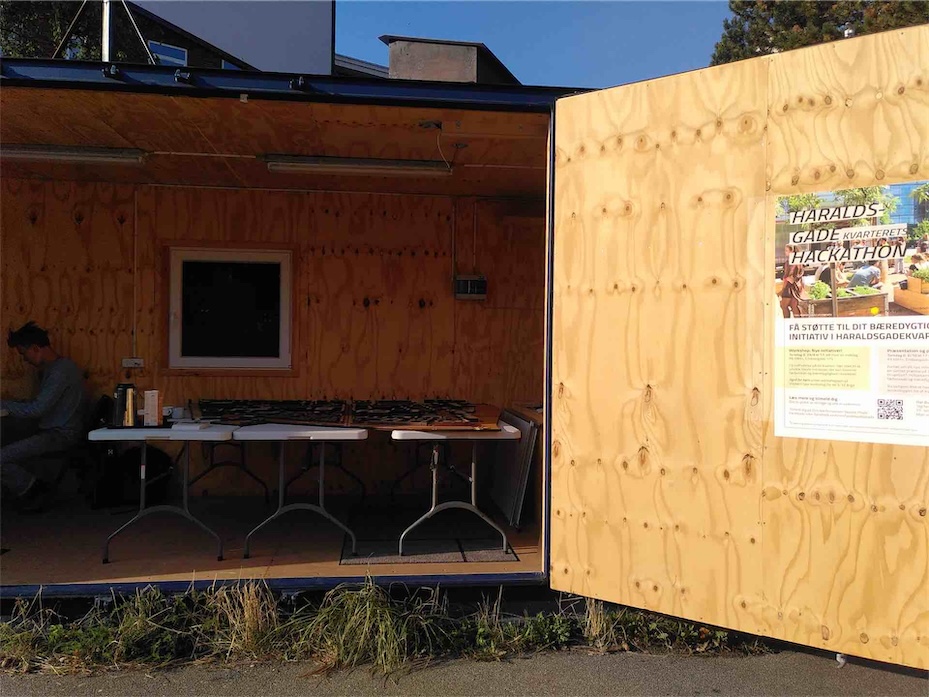
In Skjolds Plads, a mixed neighbourhood of roughly 10,000 residents in northern Copenhagen, we fitted a detailed wooden model of the neighbourhood in a decommissioned shipping container in the local square for a month – turning a planning process into an open-ended, walk-up experiment instead of a hearing. In addition to the valuable conversations with local residents that would not have shown up to any hearing, it invited a portfolio of place-specific climate solutions, co-designed and stewarded by locals. The process of engaging local residents and the ideas that surfaced were feeding into the development of the municipal climate plan proposal.
See the full Haraldsgade Hackathon case story
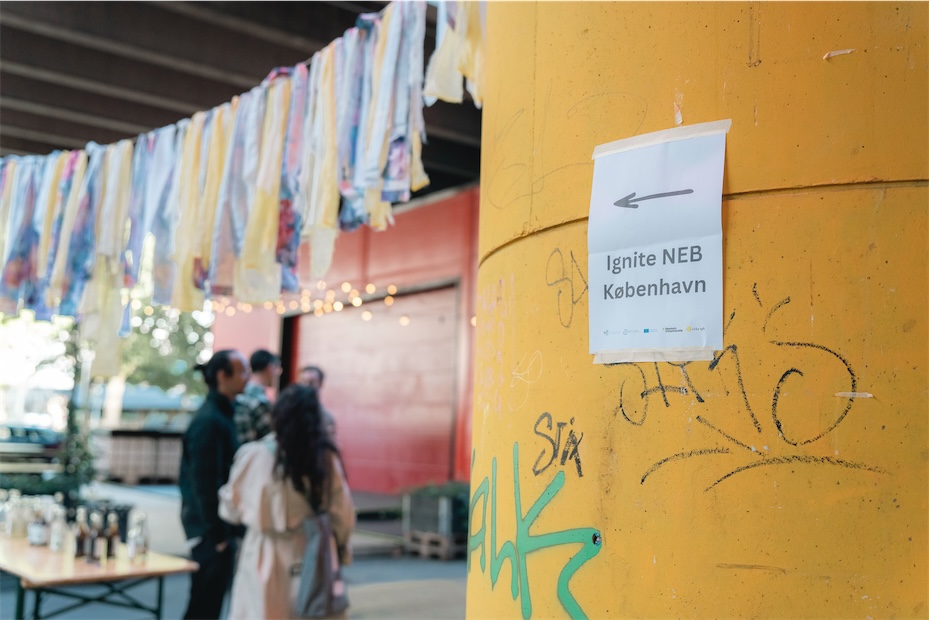
Ignite NEB is the New European Bauhaus’s entry point into its entrepreneurship pathway: an EU-funded programme designed to turn community needs into creative challenges, and creative challenges into a first prototype of a business or local social initiative. If the first case shows the local experimentation applied to gather urban and climate policy input, Ignite NEB Copenhagen shows it applied one step earlier – before an idea is considered a policy, but a lived need in a neighbourhood. As hosts, we chose to root the programme in one of the city’s most diverse neighbourhoods, inviting residents and young people as well as early-stage entrepreneurs to tackle those local challenges.
Read and watch the Ignite NEB Copenhagen success story
what this means for decision-makers
If you work in public administration, a foundation, or any organisation that commissions engagement processes, the practical question isn’t “assembly or no assembly.” It’s rather in the lines of:
Where does the idea meet reality – and how early in the process can we take it?
If the honest answer is “after we’ve finalized the initiative or policy”, I would argue that you are in fact not short on public input. You’re short on a mechanism to pressure-test it before it becomes hard and expensive to change. Real-world experimentation – hackathons, living labs, trial-funded pilots, place-based co-creation etc. – is that mechanism. It doesn’t replace deliberation, but it gives deliberation something to push against.
The organisations doing this well aren’t choosing between talking and testing. They’re iterating both: enough structured dialogue to surface the right questions followed by enough real-world trial to answer them credibly, in public, with the people who’ll live with the outcome. Running cycles until satisfied. This iterative process – not the choice of format – is what actually turns public engagement into lived policy.
FAQ
How do you turn public engagement into policy? By treating engagement as a place to build and test a policy, not just to discuss it. In practice, that means combining structured dialogue (to surface the right questions) with a real-world trial – a hackathon, living lab, or trial-funded pilot, place-based co-creation etc. – that lets residents shape and pressure-test the idea before it’s scaled or finalised.
Is a citizens’ assembly enough to create good policy? Rarely on its own. Assemblies are strong at building informed, legitimate public recommendations, but they don’t test whether those recommendations hold up once implemented. Pairing deliberation with real-world trials closes that gap.
What is place-based climate action? An approach to climate and urban policy that starts from the specific physical and social context of a neighbourhood, using local, tangible engagement (rather than city-wide consultation alone) to design and test solutions with the people who live and go there.
How is real-world experimentation different from a pilot project? A pilot usually tests a policy that’s already been decided. Real-world experimentation, as used here, is part of deciding the policy – the trial and the co-creation happen together, with the community shaping the live solution as it’s tested.
cirka cph designs and facilitates real-world engagement processes – from place-based co-creation to social entrepreneurship – for public administrations, foundations and mission-driven organisations across Denmark and the EU. If you’re rethinking how your organisation turns public engagement into policy that actually holds, get in touch!
This post was written in collaboration with AI.
