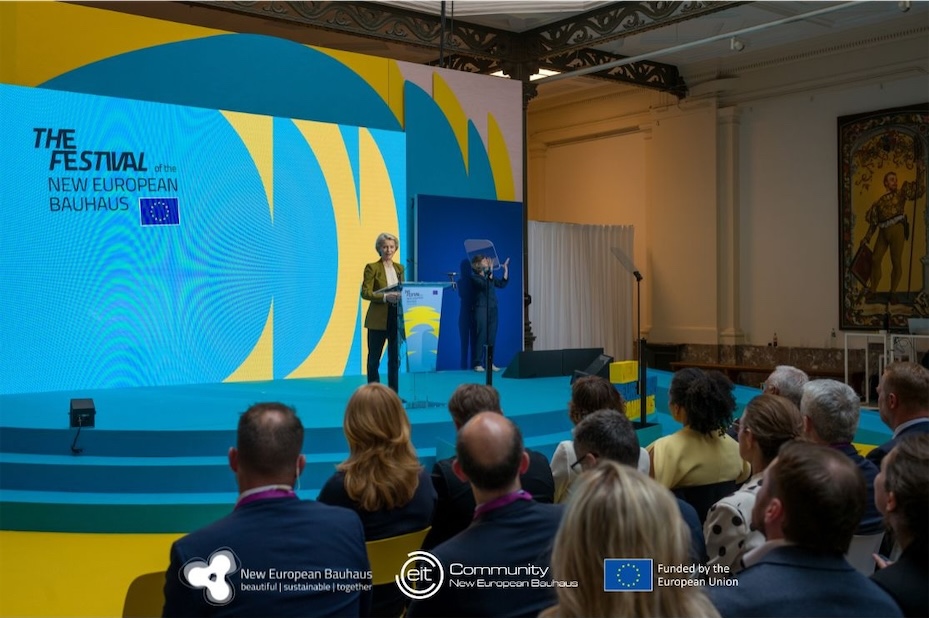
wayfinding the New European Bauhaus: an outsider’s guide to NEB programmes and funding
This is the guide to the New European Bauhaus that I wish someone had handed me when I first started trying to navigate it. First, a warning: I’m going to use the abbreviation “NEB” so many times in this post that you’ll need a break from it. However, I hope that by the end of the post you will have gotten a better sense of the NEB both through the breakdown of programmes and tales of my experiences.
I find that the biggest challenge with the NEB lies less with its very approachable policy objectives and more with the multitude, diversity, and anonymous naming of its related programmes – at least for someone trying to navigate it from far outside Brussels. I have genuinely come to like the ambitions of the policy as it’s fundamentally rethinking how policy creates impact. I consider it a potential paradigm change in EU policy.
From being a set of values, the NEB has now evolved to span a funding architecture across nine EU programmes, an entrepreneurship pathway, a knowledge hub, a biennial festival, and a community of nearly 2,000 organisations, all going by the same three-letter acronym. If you are trying to get an overview of all the NEB strands, or simply to understand which opportunity matches your project, the NEB can feel like an entirely new landscape opening up to you – one that you have to navigate without much of a map.
I hope that this post might serve as that map. Or at least help define the cardinal directions for your further research. We’ve spent the past years (since the early days of the NEB) actively engaging in a multitude of initiatives and stakeholders across the ecosystem. And I hope to see you “out there” once you finish reading this!
what is the New European Bauhaus?
In brief, the NEB is an initiative by the European Commission launched in 2020, that connects the EU’s Green Deal to the places people actually live in. Its premise is that the clean transition shouldn’t just be efficient – it should be sustainable, beautiful, and inclusive, all at once, treated as three inseparable values rather than three competing priorities. In practice, that means funding, training and community-building aimed at transforming buildings, neighbourhoods, and public spaces across Europe building its own infrastructure as well as utilising that of established programmes like Horizon Europe and eight other EU programmes. Since its conception, almost 700 projects have launched under the NEB banner in every EU member state and beyond.
Based on conversations, I believe that what gets most people confused isn’t the concept, but rather the unfamiliar “structure” of the NEB that functions as an umbrella over several distinct programmes, each with its own eligibility, timelines and entry points. Knowing which door to knock on is the critical first step – I’ll try my best to walk you through them one at a time.
the NEB programme landscape
NEB Facility (2025-2027) is the core funding tool, anchored in Horizon Europe. It has two components: a research and innovation strand (roughly €120 million a year) funding research, testing and demonstration projects, and a roll-out strand that channels funding through other EU programmes, not least Cohesion Policy, to help proven solutions scale. If you’re a public authority or research institution looking for a substantial grant, this is usually your starting point. Current calls sit under three “destinations”: connecting the green transformation with social inclusion and local democracy; circular and regenerative approaches to the built environment; and new funding and business models for neighbourhood transformation.
NEB Academy is the learning and knowledge infrastructure. Originally focused on upskilling the construction sector, it now runs on three pillars – knowledge valorisation, skills development, and innovation and business development – through a growing network of regional Hubs and, increasingly, dedicated calls run with EIT Culture & Creativity. If you want training, methodology and peer knowledge rather than project funding, this should be your starting point.
NEB Junction is the community’s shared memory. It implements the “NEB Hub for Results and Impact,” collecting, curating and circulating knowledge and results from NEB projects across Europe – including a growing knowledge base of curated case studies – so a solution tested in one city doesn’t have to be reinvented in the next. If you’re researching what’s already been tried before proposing something new, start here.
NEB Community is the network itself – and possibly the most confusing entity, because it isn’t a funding call at all. It’s the roughly 2,000 people and organisations who have formally signed up to the NEB’s values. Joining as a Partner is free, permanently open, and gets you onto the Community Platform where projects, events and collaborations get co-created. Two things worth knowing inside it: NEB Local Chapters, self-organised, place-based groups of Community members putting NEB values into practice in a specific city, region or country; and the NEB Lab, a project-based structure where Community members self-organise around a shared challenge to deliver tangible change – it doesn’t hand out funding, but it does offer visibility, mentoring and a route to in-kind and public support. For anyone who wants to be in the room where NEB collaborations start, rather than just applying to a call, this is where you engage.
EIT Community NEB is the entrepreneurship pathway, run jointly by EIT Urban Mobility, EIT Food and Climate-KIC – and the part of the NEB that I know most intimately, since it’s how we got involved in the first place. The funding calls that they offer are now structured as a journey rather than a single call:
- Ignite NEB – local, “unhackathon” events that turn a community need into a creative challenge, open to applications from organisations to host it across Europe.
- Grow NEB – an eight-month follow-on programme for Ignite NEB’s winning teams, offering mentoring, prototyping support and consumer testing. From 2026, this will be considered part of Ignite NEB.
- Catalyse NEB – a one-year acceleration programme for early-stage start-ups including the strongest teams coming out of Ignite/Grow NEB.
- Connect NEB, Co-create NEB and Enhance NEB – grassroots knowledge-sharing, citizen-led public space redesign, and multi-partner consortium programmes aimed at scaling local solutions.
- NEB Mentors – independent experts supporting beneficiaries across all of the above.
NEB Prizes and NEB Boost for Small Municipalities are the NEB’s recognition arm, split across categories for implemented projects (NEB Champions) and early-stage ideas (NEB Rising Stars). Less funding, more visibility, credibility and a route into the wider network.
The NEB Festival is the biennial in-person gathering, hosted in Brussels with satellite events across Europe – part celebration, part stocktaking, part matchmaking. Highly recommended if you like to meet inspiring people and projects in person.
NEB4All is the network of National Contact Points, which exists to help coordinate national NEB engagement and can point you toward national-level support before you need to email Brussels directly.
… I told you – it’s a lot of programmes! And maps only get you so far. I’ll share some reflections from the experience of contributing to the NEB from two distinct roles that I took on.
what attending a NEB gathering is like
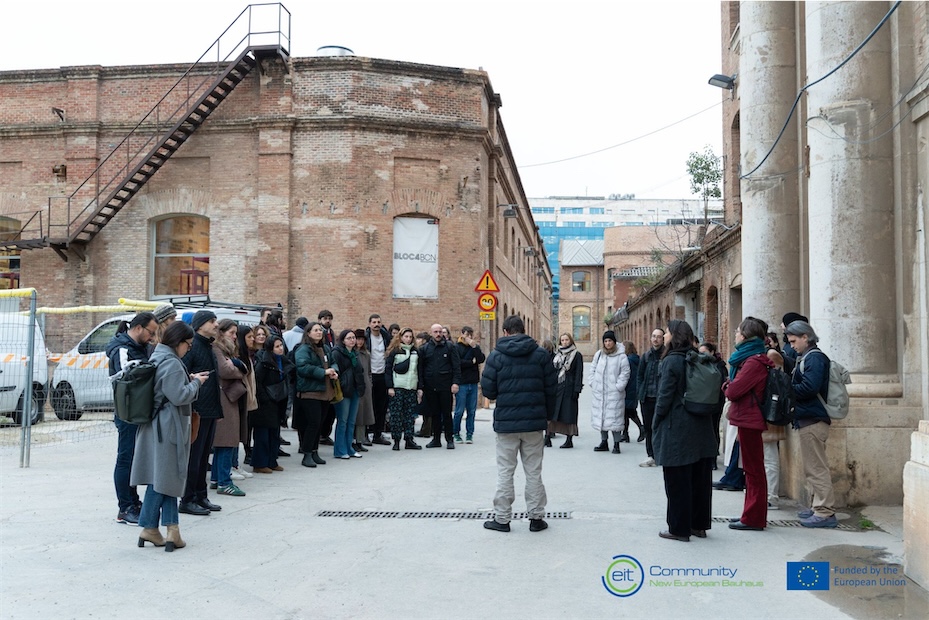
There’s a particular energy that shows up whenever people supporting or contributing to the NEB meet, whether a few dozen people or a few thousand.
I attended a gathering of EIT Community NEB beneficiaries that took place in Barcelona in January 2026, primarily in a cooperative hub called Bloc4BCN. Here, I had the pleasure of sharing a few days with other EIT Community NEB programme hosts from across Europe, carrying a wide range of job titles: public officials, founders, community organisers, researchers – all sitting in the same circle.
Across our different backgrounds, I found a fundamental frustration shared by many of the attendees: impact tends to unfold over years, not months, and it’s hard to measure and even harder to justify to a funder. Comparing notes with others approaching this frustration a little differently is where real inspiration lies. From these conversations, I have come to see the EIT Community NEB programmes as a valuable support in addressing this frustration both for me and other programme hosts – as a stepping stone in building the case for impact potential.
That sense of building on shared values carried into how we spent our time together beyond talking about our projects. Between a guided walk to visit the cooperative initiatives found throughout Can Batlló and a workshop imagining what a NEB city might look like in 2040, the gathering made the case that narrating where any transition is headed matters just as much as getting the technicalities right.
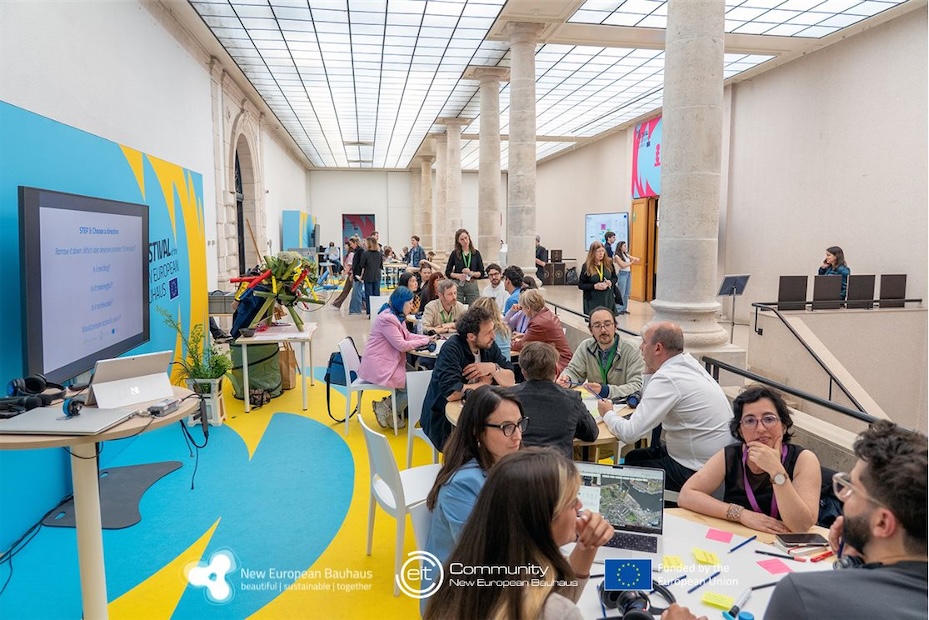
The 2026 edition of the NEB Festival in Brussels a few months later, carried that same underlying energy to a very different scale. Despite drawing a few thousand visitors over the course of the event, it managed to hold on to the sense that it all starts with people and a genuine understanding of what a community needs before jumping to assumptions. It’s about engaging locally – one person, one neighbourhood, one city at a time until it adds up to a value-based community. That’s the NEB’s bottom-up model for scaling from local to Europe-wide.
Between an Innovation Arena where start-ups showed what an idea rooted in NEB values could look like, sessions on a stage located in a huge museum exhibition hall, and after-hour community drinks and happenings, I barely caught my breath. For a good few days, I was fully immersed in the NEB vibe.
What the intimate gathering and the full-blown festival have in common is that nobody stays a stranger for long, and that the value rarely comes from the scheduled sessions alone. Cities swap notes with start-ups, researchers with community organisers, and those who already finished their projects still turn up to connect with others just getting started. I consider it less a series of separate events than one long, energising conversation that happens to reconvene in different cities throughout Europe. I was fortunate enough to take part in this conversation and I hope that you’ll find your own way into it too!
what it means to host a NEB programme
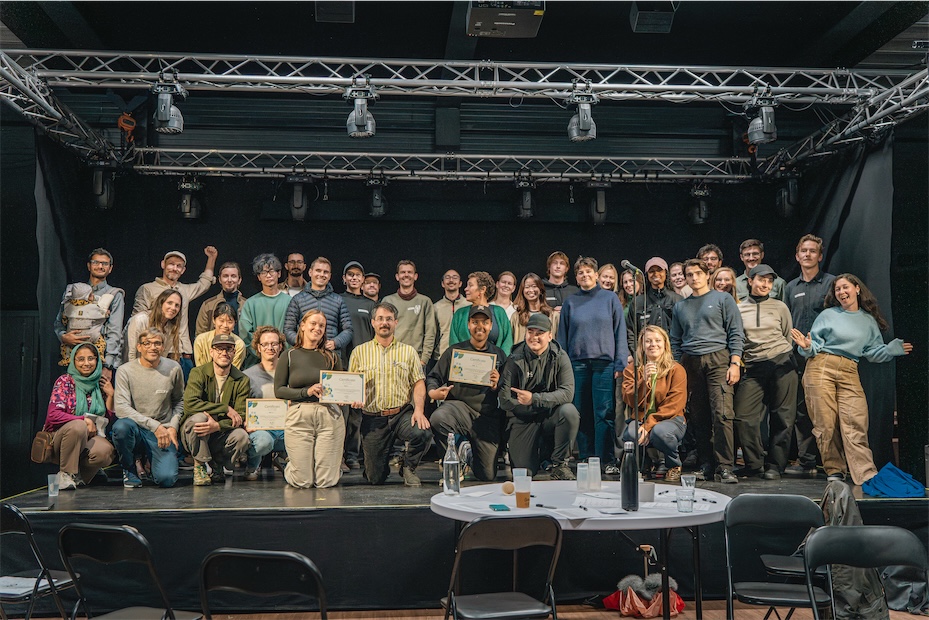
In Brussels, I was invited to contribute to a taster session for Ignite NEB with EIT Community NEB as part of the Festival’s programme. The session offered a compressed, hands-on taste of what Ignite NEB’s creative problem-solving actually feels like, aimed at people who’d never encountered the programme before. As an Ignite NEB and Grow NEB 2025/2026 host in Copenhagen, this was a throwback to the programme we hosted.
We were chosen as hosts on the basis of our proposal to root the programme in one of the city’s most diverse neighbourhoods in close collaboration with local stakeholders. As the programme unfolded, we invited residents and young people alongside early-stage entrepreneurs to tackle the identified local challenges together. This way, we managed to turn community needs into creative challenges, and creative challenges into a first prototype of a business or local social initiative led by the winning teams.
Read and watch the Ignite NEB Copenhagen success story
Hosting Ignite NEB, as well as engaging with the NEB in other roles, I am always reminded that although each of the programmes reads cleanly on paper, running one is another matter entirely. It becomes a negotiation between the local context and what was intended when the idea was conceived, presumably in Brussels. I keep being intrigued by how we can improve this negotiation to make the most of the NEB in practice.
If you’re trying to work out where your organisation fits in all of this – or you’d like to compare notes on hosting NEB programmes, talk through NEB Facility or Academy opportunities, or explore other EU-funding routes that support serious sustainability ambitions: get in touch.
This post was written in collaboration with AI.
